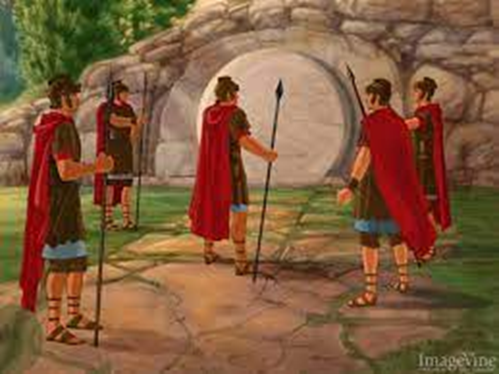
A very common argument against the resurrection asserts that our sources for Christianity's founding miracle show evidence of legendary development. This argument can be fleshed out in numerous ways. The most common of these methods is to start with 1 Corinthians 15 and work through our sources in chronological order, going on to Mark, Matthew, Luke, and John, all the while attempting to demonstrate how the story is adapting or changing—growing more elaborate over time.
These arguments may appear convincing to those who haven't read very widely, but closer inspection usually reveals them to be a tangled web of poorly evaluated evidence, cherry-picked details, and unconsidered alternatives. Popular level atheists repeat these arguments with fervor and the intellectual fallibilities so endemic to that breed of unbelief (see here), caring little for the reasoned responses that have collected dust in front of them for so many years. This is why I was interested to hear of a recent paper by Robert Greg Cavin and Carlos A. Colombetti, both persistent critics of the resurrection, which contains a section (albeit a fairly brief one) defending a Bayesian argument for legendary development. While I was hoping for a much more rigorous approach to the question, I was disappointed to find that the only difference between this particular articulation of the argument and all of its predecessors is that this one is draped in all the fetching trappings and intellectual inveiglements of Bayesian terminology and subscripted majuscules, satisfying the itching ears of the layman but ultimately reiterating its popular contemporaries. Little of what I will discuss here is new to me. But, since this argument keeps circulating, responses are still required, in the hopes that this argument will one day die forever, unlike the risen Lord whom it targets.
While the paper from which this argument is taken is 58 pages long, the Bayesian argument for the legend thesis takes up no more than 6 of these (section 4.2). I do not intend in this post to discuss the rest of the paper, in which the authors argue that the standard model of particle physics nullifies the explanatory power of the resurrection hypothesis—specifically, that a physical body could not appear and disappear at will like Jesus' could. This topic may be the subject of a future post, as there are enough problems with the authors' discussion of the legend thesis to render confidence in the rest of their work low. I am not convinced by their larger argument, though I admit my need to study the issue more.
The authors structure their argument as follows. They define L as "the hypothesis that the New Testament Easter traditions that relate group appearances of the Risen Jesus did not originate on the basis of eyewitness testimony but arose, rather, as legend." (85-86) They define ~L as "the opposing hypothesis that these traditions arose from the testimony of eyewitness [sic] to the group appearances they relate." (86).
Cavin and Colombetti defend five pieces of evidence for L, labeled D1-D5. In footnote 86 they admit that they think the list is "much more expansive". However, it is entirely reasonable to assume that they have selected some of their best examples, so if these fail in confirming L it is unlikely that the other examples would deliver the necessary evidential weight for their argument to work; this is especially true if, as will be seen, the evidential value of the data point is delivered in each case by the same faulty methodology—the strength of the legend thesis is not bolstered by increasing the number of unsuccessful data points from five to twenty. Accordingly, restricting this analysis to D1-D5 will provide an adequate summary of the strength of their case, and to a lesser extent, the strength of the legend thesis as a whole.
After discussing the five data points, the authors argue that the evidential weight of D, the conjunction of D1-D5, is sufficient to overcome a prior probability for L of 0.0001 and render P(L|D) ≥ 0.999. This is a bold claim that relies entirely on how much weight should be given to D1-D5. Thus, each of these will be examined in turn. It will be concluded that the conjunction D provides at most negligible evidence for L, thus leaving the legend thesis unconfirmed.
And finally some advisory notes: there is a pervasive redundancy to many of my responses. The authors rely on many of the same arguments throughout their work, so multiple counterpoints are reiterated numerous times. I have decided to retain some of this redundancy in the hopes that this post is easier to use for reference purposes, as its slightly longer nature may deter some from reading it all the way through. I have also addressed some objections to the historicity of certain passages that the authors themselves don't raise. It is entirely possible that I have misunderstood, misrepresented, or mishandled their argument, and I welcome correction on this score. I have tried to think of possible responses the authors could raise to the criticisms in this post and respond accordingly, but I can only do so much.
Without further ado, here are my comments on Robert Greg Cavin and Carlos Colombetti's published case for the legend thesis.
D1: no appearances in Mark
The first data point concerns appearance traditions (or lack thereof) in Mark's Gospel. To ensure I am not misrepresenting their argument, I will quote the full paragraph:
"Let us first consider the earliest Gospel, Mark. Since L hypothesizes that the Easter traditions evolved as legend, it is not improbable on L that Mark would contain only the tradition of the discovery of the empty tomb and thus no traditions of appearances of the Risen Jesus to his followers. In contrast, this is unthinkable on ~L since this hypothesizes that all of the New Testament Easter traditions are historical fact based on eyewitness testimony. In fact, however, Mark relates only the discovery of the empty tomb and no appearances. This is in marked contrast to the other three gospels, which contain detailed and highly elaborate accounts of the appearances of the Risen Jesus. Call this difference between Mark and the other sources 'D1.' Then it is clear that D1 confirms L to a greater degree than ~L. Some have attempted to argue that the original manuscript of Mark did contain a final section relating appearances of the Risen Jesus but that this was somehow lost in the later copies. Yet this would be virtually impossible on ~L given the supposedly extreme care the early church exercised in transmitting, maintaining, and copying its sacred documents." (86-87, emphasis mine)
I agree that Mark is the earliest Gospel. I will also grant the first part of this argument: the fact that Mark's resurrection narrative emphasizes the empty tomb and not the appearances is not that improbable on L (though one might defensibly conjecture otherwise). However, in order for this observation to have any evidential weight, it has to be shown that Mark's account is improbable on ~L—in other words, we need some reason to think that the account would have been construed significantly differently if legendary development was false. This is what the authors attempt to do in the next portion of the paragraph, which I have italicized. They give two considerations in support of this contention: 1) ~L "hypothesizes that all of the New Testament Easter traditions are historical fact based on eyewitness testimony", (call this D1-ET) and 2) the other Gospels "contain detailed and highly elaborate accounts of the appearances of the Risen Jesus" (call this D1-OG). Both of these considerations may seem convincing to the reader who is merely skimming the article without fully engaging his cognitive faculties, but closer examination reveals them to be very weak.
D1-ET argues the following:
P1: ~L hypothesizes that the Easter narratives are historical fact based on eyewitness testimony.
P2: Mark doesn't contain any "traditions of appearances of the Risen Jesus to his followers"
P3: (implicit) If the Easter narratives are historical fact based on eyewitness testimony, Mark would likely have contained appearances of the risen Jesus.
C1: Therefore, if ~L, Mark would likely have contained appearances of the risen Jesus. (from P1 and P3)
C2: Therefore, Mark's omission of appearances is evidence against ~L.
Where to begin? The most obvious problem with this argument is that Mark does contain "traditions of appearances of the Risen Jesus to his followers", so P2 is false. Consider Mark 16:7: "'...But go, tell His disciples and Peter, "He is going ahead of you to Galilee; there you will see Him, just as He told you."'"
I also take issue with P1. Remember, ~L is
defined as the "hypothesis that
these traditions arose from the testimony of eyewitness to the group
appearances they relate." By this definition, ~L doesn't require the Easter narratives to be "historical fact" in the strictest sense of the term—only that they are generally reliable and contain no deliberately exaggerated falsehoods. There is room for good faith errors under the umbrella of ~L. Larger contradictions could constitute evidence against the eyewitness testimony hypothesis, but small disagreements are not at all improbable.
Though Cavin and Colombetti have already overstated their case, these gripes are somewhat pedantic as the argument can be reformulated to avoid these difficulties. There are at least two ways we can reformulate P2: Mark doesn't narrate any appearances of Jesus, or, his reference to an appearance lacks the detail of the later Gospels. The second of these options overlaps significantly with D1-OG, which will be examined next. Thus, in an attempt to salvage D1-ET, we will use the first of these options (by "narrate", I mean a recounting in narrative form as we see in the other three Gospels). Finally, P1 needs to be softened to incorporate a more robust account of historical reliability. Here is my proposed reformulation of D1-ET:
P1: ~L hypothesizes that the Easter narratives are historically reliable accounts based on eyewitness testimony.
P2: Mark doesn't narrate any appearances of Jesus—he merely alludes to one.
P3:
(implicit) If the Easter narratives are historically reliable accounts based on
eyewitness testimony, probably, Mark would have narrated appearances of
the risen Jesus.
C1: Therefore, if ~L, probably, Mark would have narrated appearances of the risen Jesus. (from P1 and P3)
C2: Therefore, Mark's omission of appearances is evidence against ~L. (from P2 and C1)
P1 and P2 can now be granted. The crucial premise, then, is the third. If Mark was recounting eyewitness testimony (possibly from Peter, per external attestation) would he have narrated appearances of the risen Jesus? Despite going so far as to call Mark's omission "unthinkable", Cavin and Colombetti do not provide any justification for P3 beyond that adjective.
The authors anticipate the objection that the ending of Mark was lost and provide a reason for rejecting it. For the sake of argument, I will grant that Mark's Gospel originally ended at verse 8. I will proceed on this assumption because it is the more favorable scenario for the authors' thesis, and their thesis needs all the help it can get.
The first point to be made concerns a rather fundamental flaw repeated throughout this section of the paper—an overemphasis on the argument from silence. As has been shown numerous times, ancient authors often omitted seemingly important events; as to the reasons for these omissions we can only speculate. Here is a list with some examples. To pick just two, Pliny the Younger never mentions the destruction of Pompeii in his account of the eruption of Vesuvius, and Marco Polo forgoes entirely any mention of the Great Wall of China, despite his journey right past it. This is not to say that arguments from silence carry no weight, but rather that much caution is necessary when employing them in historiographical argumentation. To apply this principle to D1-ET, it should be noted that Mark's failure to narrate appearances is only very weak evidence against him having been aware of them.
Two further observations strengthen this contention.
First, Mark was aware of at least one appearance but he didn't narrate it. Whatever reason given for this omission can be applied, to some degree, to the question of why Mark didn't narrate any other appearances. Let's suppose that Mark merely alludes to, not narrates, the appearance in verse 7 in order to end his narrative with a note of suspense. Or perhaps he wanted to emphasize the resurrection as the climax, causing him to forgo a lengthy denouement in which Jesus appears to the disciples. Other possibilities include Mark lacking sufficient knowledge about the appearance, assuming that the traditions of the appearances were well-known enough that further mention of them was unnecessary, or desiring to keep his account to a shorter length. More possibilities could be given. If the authors were to accept one of these explanations, they would have to explain why this isn't applicable, at least in part, to the other appearances that Mark omits. If the authors were to reject all of these explanations and claim ignorance as to the reason for Mark's omission, they undercut any grounds for demanding an explanation of Mark's omission of other appearances. So regardless of the truth of the legend thesis, we still have to explain Mark's omissions. This is not merely a problem for proponents of ~L.
Second, the creed in 1 Corinthians 15 lists several appearances. It's implausible Mark was completely unaware of them since they were circulating in credal form. There is dispute over how much is original to the creed and how much was added via a Pauline redaction, but the point still holds. The tradition of multiple postmortem appearances of Jesus originated early and there was ample time for it to spread. So if we grant that Mark was aware of at least a handful of postmortem appearances, this implies that Mark chose not to include certain appearances. At this point, it is not even incumbent upon me to provide a reason for Mark's omission—the mere fact that he did shows that the Easter narratives were more elaborate at the time than Mark portrays. This is sufficient to undercut the claims of L, because the only way for the authors' argument to work is to show that traditions of appearances developed later, or that Mark was unaware of them while he was writing. The latter is clearly off the table because of verse 7, and is improbable for other reasons. But If the authors opt for the former, they are faced with the highly complicated hypothesis of inconsistent legendary development because of the evidence from 1 Corinthians 15. Either way, the argument fails.
The only possible response I can anticipate is that appearance narratives are more expected if the author in question actually witnessed the event—it would persist vividly in Mark's mind and thus be more likely to be included in the account than if it was merely a legend with which he had no firsthand familiarity. In other words, the experience of the appearance would render an account of it more probable. This response fails because 1) Mark himself never claims to be a witness to the resurrection, so it may well be that he never saw the risen Jesus, and 2) Mark shows no qualms about narrating things he didn't experience, such as the women's discovery of the empty tomb.
Let us now examine D1-OG, the second justification given for D1: differences in the appearance traditions in Mark vs. the other Gospels. The authors formulate the claim thusly: "In fact, however, Mark relates only the discovery of the empty tomb
and no appearances. This is in marked contrast to the other three
gospels, which contain detailed and highly elaborate accounts of the
appearances of the Risen Jesus." (86)
We have already seen that Mark does contain an appearance tradition, though it is not narrated. The claim defended here could take two forms, concerning quantity and quality: 1) Mark contains fewer appearances, and 2) Mark doesn't contain detailed appearances as related in the later Gospels (touching, speaking, conversing with Jesus). The first of these has been addressed in the previous section. Several points can be made concerning the second.
First, the problems with the argument from silence automatically places a firm upper bound on the potential strength of our conclusions. Second, Mark doesn't narrate any appearances, so we simply don't know what sort of appearances he would have narrated. It is circular to claim they would have been non-physical (or something similar) because of legendary development—that assumes the very thing the authors are trying to prove. Third, the general agreement on the details of the appearances tells against legendary development. The earliest appearance to be fully narrated, as opposed to terse summaries or allusions like in 1 Corinthians 15 and Mark, is found in either Matthew or Luke (depending on which solution to the Synoptic problem is correct) and is polymodal: Jesus appears to a group, talks, and is touched. This pattern continues unbroken throughout the later Gospels. So what reason is there to think Mark conceived of the appearances differently? In this case, the burden of proof rests on the claim that Mark's beliefs about the appearances were different from the unanimous testimony of the other three Gospels.
In summary, we have examined two arguments for the evidential value of D1. After reformulation, D1-ET was seen to fail on the grounds of (1) Mark's allusion to an appearance in 16:7, (2) Mark's omission of a narration of that appearance, (3) the ease with which possible explanations for (2) can be applied to any other appearances Mark omits, (4) Mark's probable knowledge of other appearances and his deliberate omissions thereof, and (5) the tenuity of the argument from silence. D1-OG could be formulated in two ways. The first of which fails for the same reasons as D1-ET. The second fails on the grounds of (5), (6) Mark didn't narrate any appearances, meaning we simply don't know what details they would have included, and (7) all of our sources which do contain direct narrations of postmortem appearances are in agreement that they were physical and polymodal. These seven considerations compel the conclusion that D1 is of no evidential value in confirming legendary development.
D2: the appearance to the 500
One arrow has missed the target, but the authors have four more to shoot. The next paragraph of Cavin and Colombetti's paper argues that the attestation of the appearance to the 500 is best explained by L:
"Consider next the report Paul passes along in 1 Cor. 15:6 of an appearance of the Risen Jesus to more than five hundred witnesses at one time. As [William Lane] Craig himself concedes, there are a number of scholarly questions that remain unanswered regarding this report, e.g., its source and date. Nonetheless, given the apologetic importance of this report in combating the first century version of the Hallucination hypothesis, it is inconceivable on ~L that it should not be found in other New Testament sources, viz., one or more gospels. Yet, unfortunately for ~L, it is not. It occurs only in 1 Cor. 15:6. For L, in contrast, this is no problem. Indeed, on L, the failure of other sources to mention the appearance to the five hundred is to be expected because it never actually happened. Call this difference between 1 Cor. 15:6 and the four gospels “D2.” Then it is clear that D2, like D1, confirms L to a greater degree than ~L. But there is an objection. We know from Paul himself in Gal. 1:18‒2:14 that he met with Cephas and James in Jerusalem on two occasions and with Cephas in Antioch on yet another. As C. H. Dodd famously quipped, “We may presume that they did not spend all their time talking about the weather.” Thus, if, as L states, the appearance to the five hundred did not occur, wouldn’t these apostles most probably have let Paul know? The answer, ironically, is “No.” The problem is that the early church had far more pressing matters to debate at that time: gentiles, the validity of the Old Testament law, circumcision, dietary laws, etc. It is highly unlikely given their preoccupation with these issues that the appearance to the five hundred would have even come up. Thus, D2 does more strongly confirm L." (87, emphasis mine)
In this section, I will defend the claim that D2 is at most negligible evidence for L. Then, I will defend the claim that D2 actually tends to disconfirm certain versions of the legend thesis, though Cavin and Colombetti's formulation avoids this evidential counterweight.
Here is 1 Corinthians 15:3-6:
"For I handed down to you as of first importance what I also received, that Christ died for our sins according to the Scriptures, and that He was buried, and that He was raised on the third day according to the Scriptures, and that He appeared to Cephas, then to the twelve. After that He appeared to more than five hundred brothers and sisters at one time, most of whom remain until now, but some have fallen asleep."
To avoid tedious verbal repetition, I will use "A500" to refer to "the appearance to the 500". While it is possible that the Galilee appearance recounted in Matthew 28:16-20 is A500, this is too speculative to bear on the argument. Accordingly, we will proceed on the assumption that A500 occurs only in 1 Corinthians 15, thus granting D2. Cavin and Colombetti argue that D2 is "inconceivable" on ~L but "expected" on L. I will argue that both of these contentions are false.
I will begin with the first contention, the authors' defense of which I have italicized in the quote at the beginning of this section. I have attempted to represent it (we'll call this argument D2-H) using symbolic logic. Admittedly, the certainty implied by symbolic logic is a bit incongruous to the probabilistic task of historical inquiry; however, the authors claimed that D2-H renders "inconceivable" the targeted probability judgment (which saddles them with a heavy amount of certitude to defend), and the clarity of symbolic logic will assist in discovering the epistemic options available to one who denies the conclusion. The reader is welcome to mentally insert "probably" or "likely" before any claim where such a qualification would be fitting.
D2: A500 appears only in 1 Corinthians 15
C: the Gospel authors wanted to combat the first century version of the hallucination hypothesis
B: the Gospel authors believed A500 happened
H: A500 would have been sufficiently helpful in combating the first century version of the hallucination hypothesis such that omitting it is difficult to explain
LA: A500 was a legendary development
L: the authors' legendary development thesis
P1: If (C ∧ B ∧ H), probably, ~D2
P2: D2
C1: Therefore, probably, ~(C ∧ B ∧ H) (modus tollens)
C2: ~C ∨ ~B ∨ ~H (DeMorgan's law)
P3: C
P4: H
C3: Therefore, ~B
P5: If ~B, probably, LA
P6: If LA, D2 is evidence against ~L
C4: Therefore, D2 is evidence against ~L
P1 and P2 may both be granted. This means that the important part of the argument is the second conclusion: either C, B, or H must be false. I will examine these one at a time.
Strictly, C states that the Gospel authors wanted to combat the first century version of the hallucination hypothesis, or that they wanted to show that Jesus had a physical body. This is probable. In all three of the Gospels which narrate appearances, Jesus is seen, heard, and touched. In Luke and John the emphasis is even more explicit. So it seems likely that the Gospel authors intended to show that Jesus was not nonphysical. It is worth noting that this does not refute the historicity of these episodes—it is likely that Jesus really would present himself in that way to assure his disciples of his resurrection, and further that the disciples would remember this and include it in the Gospel accounts to support the reality of their Lord's resurrection. C, then, is plausible, and will be granted.
B remains an open question—we don't know whether the Gospel authors knew about A500. If it happened, however (and I think it did), it certainly seems more probable than not that the Gospel authors would know about it. There are other reasons to think this as well (the earliness of that tradition, their likely familiarity with the letters of Paul, and circulation by word of mouth). Thus, B will be granted as well.
Accordingly, I must deny H to avoid the conclusion. Fortunately, H is the weakest claim of the three. Given that the Gospels already supply ample evidence to refute the hallucination hypothesis (in the form of touching and speaking with Jesus), there is no reason to expect that they would also include A500 in addition to everything else. All three of the later Gospels include group appearances of Jesus to the disciples, therefore possessing almost all of the evidential benefits of including A500. The Gospel authors had limited space and we already know that they were omitting things (e.g., Mark omits narration of appearances despite acknowledging that they happened). Further, accounts of making physical contact with Jesus, rather than larger group appearances, would probably be more convincing to first-century Palestinians anyway. The evidential obsession with the improbability of group hallucinations is largely a trend of modern apologetics. To assume that individuals living in the first-century would share the same concerns on the evidential value of group appearances exceeds the limits of permissible conjecture. The earlier discussion of the argument from silence is also applicable here. In summary, then, even if the Gospel authors were concerned about ruling out hallucinations, it's not surprising that A500 is omitted.
Another interesting point can be made via a thought experiment. Suppose that A500 was found exclusively in the Gospel of John, probably our latest source. Would the authors argue this is evidence for L? It certainly seems so. It's an appearance to far more people than recorded anywhere else, and it would be coming in our latest source. Of course, this wouldn't mean it must have been the result of legendary development, but the evidence would be present nonetheless. This raises an interesting epistemic dilemma—Cavin and Colombetti would argue that A500 is evidence for legendary development whether it appears in our earliest source or our latest source. Given their arguments for D3-D5, it seems likely they would think the same thing if A500 appeared in just one of our intermediate sources.
This means that the evidential value of A500 is not that it's only in our earliest source instead of a later one but rather that it's only in one source instead of multiple. Accordingly, by the authors' standards, the only way in which A500 doesn't count for legendary development is if it's attested in multiple sources. But why think that? Does every event of ancient history need to be recorded multiple times before we can accept it? Obviously not. Different authors are selective in what they include in their narratives—one author may have more information than another about a certain appearance, or one author might think there's a more important appearance to narrate.
I'll formulate this argument as follows:
P1: A500 would be just as much, if not more, evidence for L if it was found only in John's Gospel.
P2: By the authors' own standards, A500 would be evidence for legendary development if it was found only in any one of the intermediate accounts.
P3: If P1 and P2 are true, then the issue is single attestation, not time of attestation.
C1: Therefore, it doesn't matter what source A500 appears in because the issue is single attestation.
P4: Single attestation is not a problem.
P5: If single attestation is not a problem, D2 is not evidence for L.
C2: Therefore, D2 is not evidence for L.
All this is a fairly long-winded way of saying that D2 is unsurprising on ~L. While this is sufficient to nullify their argument, I will now turn to their defense of their second contention: "For L, in contrast, this is no problem. Indeed, on L, the failure of other sources to mention the appearance to the five hundred is to be expected because it never actually happened." Cavin and Colombetti seem to be arguing the following:
P1: If an event never happened, singular attestation is "to be expected".
P2: L predicts that A500 never happened.
C1: Therefore, singular attestation of A500 is to be expected under L.
The conclusion is not actually unfavorable to the proponent of ~L, but there are reasons to be skeptical of premise 1. To start, we have multiple attestation of many things in the Gospels which most skeptics would deny. The resurrection is an obvious example, but there is also the empty tomb simpliciter, Jesus walking on water, the feeding of the five thousand, and the triumphal entry on a colt. For someone who denies the latter events, they are faced with an inconsistency in accepting P1. Moreover, if the Gospel authors believed A500 (which we have defended earlier), the authors must explain why they still failed to include it. As we saw with D1, any reason given for this omission can be broadly applied to their contention that it would have been included in the Gospels if it actually happened. Thus, the easiest way forward for the authors is to reject that the Gospel authors believed A500, which is a very tenuous position.
Nonetheless, single attestation is at least somewhat more probable than multiple attestation if the event in question is a legend, so a weak form of C1 can be granted. The important point, however, was defended in the earlier section—single attestation is not at all improbable on ~L.
It is worth noting that D2 actually tends to disconfirm certain forms of the legend thesis. Consider my earlier argument that what's at stake here is not that A500 appears only in our earliest source but rather that it's attested only once. We've established that single attestation should not be a problem for historical inquiry. The relevant issue, then, is where the attestation is, and this is where the authors' argument is weakest, because this legendary "development" is found in our earliest source! We have no earlier source with which to compare the creed. As far as we know, this represents the earliest version of the story. And yet, A500 appears here and nowhere else. For someone claiming that the resurrection accounts grew more elaborate over time, this serves as a counterexample in which an extraordinary detail appears early and then disappears completely. Though this is useful in arguing against certain popular-level forms of the legend thesis, Cavin and Colombetti have instead targeted the issue of single attestation, so this critique is only minimally relevant to their argument.
Some comments are in order on the rest of the paragraph before we evaluate D3. First, though I think the authors are right in arguing against the probability of the apostles correcting Paul on A500, this doesn't account for the possibility that the apostles themselves believed (if mistakenly) in the accuracy of A500. In fact, there is some reason to think that the resurrection message proclaimed by the early church was the same:
"If we give 1 Cor 15:11 ["whether then it was I or they, so we preach and so you believed"] its due weight, it follows that there existed at the very beginning of earliest Christianity, not an unlimited diversity of conflicting Christologies and confessions, but instead this one gospel of Jesus Christ."If the mention of A500 is part of the original creed, rather than a Pauline redaction, it follows that this belief was widespread early on. None of this is certain, but we should be cautious before concluding that Paul's beliefs about the resurrection differed radically from everyone else's.
Martin Hengel, ‘Das Begräbnis Jesu bei Paulus und die leibliche Auferstehung aus dem Grabe’, Auferstehung – Resurrection, 119-83.
To summarize, Cavin and Colombetti argue that D2 is inconceivable on ~L and expected on L. The latter of these claims is plausible but we should be skeptical because (1) we have multiple attestation of many things that skeptics would reject, and (2) it forces us to assume that the other Gospel authors didn't know of it or didn't believe it, which is implausible on other grounds. The defense of the former claim (D2-H) fails because of (3) the weaknesses of the argument from silence, (4) the limited space and thus the required omissions of the Gospel authors, (5) the fact that we know the Gospel authors were omitting things, such as Mark's allusion to but not narration of an appearance, (6) the Gospels already include arguments against the hallucination hypothesis in the form of touching Jesus, (7) the Gospels already include group appearances, (8) it's unlikely first-century Palestinians were as evidentially concerned about group hallucinations as modern apologists, and (9) it is poor historiography for single attestation to be evidence against historicity. Further, we saw that D2 is evidence against other forms of the legendary development hypothesis and that there are reasons to be skeptical of proposed disparities in the details of early Christians' resurrection belief.
We conclude that D2 is at most negligible evidence for L.
D3—Matthean details
The third piece of evidence adduced for legendary development concerns details unique to Matthew's Gospel.
"We turn now to Matthew. This gospel contains the dramatic narrative (28:3‒4) of an angel descending from heaven and rolling away the stone from the tomb as the frightened guards watch. It also contains a narrative (vv.16‒20) of the Risen Jesus appearing to the disciples on a mountain in Galilee and commanding them to baptize in the Trinitarian name. Given the significance of these traditions in combating disbelief in the Resurrection and promoting belief in the Trinitarian nature of God, it is difficult to understand on ~L how they should not be found in (at least) one of either Luke-Acts or John. More importantly, given the fact that it is the Risen Jesus himself who is issuing a solemn command to baptize in the name of the Trinity, it is unthinkable on ~L that these traditions should not be found in all three of the other Gospels or in Paul. On L, in contrast, this is precisely what we would expect. And, indeed, we find neither of these traditions in either Mark, Luke-Acts, John, or Paul. Moreover, Acts depicts baptism only in the name of Jesus—which is also to be expected on L. Call these differences between Matthew and the other Gospels 'D3.'" (87-88)In footnote 83, the following is added:
"Matthew also contains a very brief account of an appearance of the Risen Jesus to Mary Magdalene and the other Mary as they return to Jerusalem from the empty tomb. Jesus commands the women to tell the disciples to go to Galilee to see him. This account appears in no other sources and is best understood on L as a creation of the author of Matthew as a literary device to explain how the disciples, having fled the crucifixion, nonetheless went to Galilee to see the Risen Jesus on the mountain there. It is, of course, pointless on ~L since, according to this hypothesis, the disciples do not flee from Jerusalem but remain there for the appearance of the Risen Jesus on Easter Sunday."
At this point, it is becoming clear that all Cavin and Colombetti are doing to support their legend thesis is pointing out incidents that are unique to one source and claiming that their omission is "inconceivable" or "difficult to understand". As stated earlier, my critiques of each attempt at repackaging this canard will thus be similar.
The three Matthean details taken to be evidence of legendary development are 1) the guards watching the stone be rolled away, 2) the appearance to the disciples in Galilee evaluated alongside the appearance to Mary Magdalene and the other Mary, and 3) the Trinitarian baptismal formula. It is certainly odd that the authors chose these details when there are more plausible candidates to be found (for example, the resurrection of the saints). In fact, I think the conjunction of various such details in Matthew's account is some evidence for the legend thesis (though not enough to establish it when the data are weighed holistically). I will begin my analysis by assessing the three examples chosen by the authors and then, for the sake of completeness, I will comment on the other Matthean details.
The angel descending and the guards watching
Notably, Cavin and Colombetti do not mention the guards at the tomb simpliciter as evidence of legendary development but rather emphasize the fact that the guards saw the stone rolled away. Here is Matthew 28:1-7:
"Now after the Sabbath, as it began to dawn toward the first day of the week, Mary Magdalene and the other Mary came to look at the tomb. And behold, a severe earthquake had occurred, for an angel of the Lord descended from heaven and came and rolled away the stone, and sat upon it. And his appearance was like lightning, and his clothing as white as snow. The guards shook from fear of him and became like dead men. And the angel said to the women, 'Do not be afraid; for I know that you are looking for Jesus who has been crucified. He is not here, for He has risen, just as He said. Come, see the place where He was lying. And go quickly and tell His disciples that He has risen from the dead; and behold, He is going ahead of you to Galilee. There you will see Him; behold, I have told you.'"
The exact sequence of events is difficult to discern. It's unclear whether Matthew is saying the women witnessed the angel descending from heaven and the guards shaking from fear or whether this occurred prior to the visitation of the women. John Wenham argues for the latter—the passage should be translated in the pluperfect.
The authors argue that this passage is unexpected on ~L "given the significance of these traditions in combating disbelief in the Resurrection". It is unclear what exactly they are trying to argue. Is the resurrection less believable in the other Gospels because we don't have this specific narrative? Clearly not. If the resurrection really happened, there would be a plethora of historical material from which the Gospel authors could draw to support the reality of the resurrection. The fact that the Gospels differ in their selections of this evidence does not count against historicity.Again, then, the authors raise an interesting point but fail quite markedly in their defense of it.
Can a stronger case be made that this pericope is unexpected on ~L? I think the best way to marshal these verses as evidence for L is to say that no one could have seen this occur, and thus, Matthew must be inventing things to make his resurrection narrative complete. However, there is nothing here which couldn't have been reliably inferred from the women's testimony. If the women saw an angel sitting on the stone, it's easy to infer that the angel must have descended from heaven (where else) and rolled away the stone (how else would it have been moved). No one needs to witness that to conclude that it happened, so Matthew's inclusion of it doesn't necessarily mean he's playing loose with the facts. Whence came the information about the guards shaking with fear is a different issue, and overlaps with the question of where Matthew got his information in 28:11-15. A possible situation is that Joseph of Arimathea circulated the information—it was his tomb, after all, and he would likely have been involved with the legal procedures for guarding it. Caleb Jackson discusses that possibility in this post.
However, since this post is meant as a direct response to Cavin and Colombetti's case for legendary development, I will not spend too much time making their arguments for them. Their own case for viewing this passage as legendary (combating disbelief in the resurrection) fails, and the intuitive appeal of thinking Matthew fabricated this for narrative purposes is complicated under closer scrutiny. These points render this passage evidentially trivial in confirming L.
The Galilee issues with the disciples and the women
As an aside, it's worth noting that it's highly unlikely Matthew meant that Jesus appeared only to Mary Magdalene and the other Mary. Even though these are the only two women he names, he never says that these were the only women who went to the tomb. A similar phenomenon can be found in both Luke and John's accounts of the resurrection. Luke names only Peter confirming the empty tomb (24:12) but later quotes Peter as saying "And so some of those who were with us went to the tomb, and found it just exactly as the women also had said; but Him they did not see." (24:24). Even though only Peter is named, it is understood that multiple people went to the tomb with Peter—a detail which is confirmed by John's account, which lists Peter and "the other disciple" as going to the tomb (20:3). John's account provides another example of this phenomenon. He lists only Mary Magdalene as going to the tomb (20:1) but then quotes her as saying to Peter "They have taken the Lord from the tomb, and we do not know where they have put Him.” Again, we have more people in view here than are named in the narratives. There is no reason to think Matthew is doing anything different when he names Mary Magdalene and the other Mary. This is a somewhat pedantic gripe as it doesn't threaten the substance of the argument in question but it is a worthwhile clarification given the authors' demonstrated sloppy handling of the source material.
The authors' argument for this being legendary are found in footnote 83. They begin by noting that it is found in no other sources. So what? Enough has been said already in this post about single attestation. They postulate that Jesus' command to go to Galilee is a literary device to explain why the disciples went to Galilee instead of remaining in Jerusalem. It's worth noting that the mere fact that Jesus' command explains the next part of the story is not at all a reason to doubt the historicity of either portion. Generally, real-life events follow a logical sequence, so if Matthew is reporting events as they happened, it's quite natural for him to retain this logical sequence.
It might appear that Matthew's account is compressed—the angels tell the women that Jesus will appear in Galilee, the disciples go there, and Jesus gives the Great Commission. At first blush this appears to be inconsistent with Acts 1:3, which says that the risen Jesus was on Earth for 40 days following the resurrection. Is Matthew saying there were only two appearances?
However, there are a couple ways to avoid this tension. The obvious difficulty is that it assumes the Great Commission was given right before the ascension. While this is certainly a dramatic way to ascend into heaven (see here) there is no reason to think this is what Matthew is saying, especially since Luke is clear that the ascension took place outside of Jerusalem. Nor need it be assumed that Matthew thinks this appearance to the disciples was the first, as noted by John Wenham:
"Although this one in Galilee is the only appearance to men mentioned by Matthew, his wording contains a hint of an earlier meeting: 'The eleven disciples went... to the mountain to which Jesus directed them.' Thus far, Matthew has spoken only of the angel's message that they were to see Jesus at an unspecified place in Galilee. Now he speaks of the mountain to which Jesus had directed them. The specific direction could of course have come from Jesus through the angel without Matthew saying so, but given our knowledge of meetings of apostles with Jesus from the other gospels, it seems likely that he was thinking of an occasion at which Jesus himself told them precisely where and when to assemble."
Easter Enigma, (Eugene: Wipf and Stock Publishers, 1992) p. 113In summary, it's simplistic to assume that Matthew's narrative consists of only two appearances, the first explaining the second, after which Jesus ascends to heaven. Matthew's account does not demand this and should not be forced into tension with the other Gospels.
The Trinitarian baptismal formula
Generally, doubts concerning the historicity of the Trinitarian baptismal formula primarily stem from either of two concerns. After these are addressed, Cavin and Colombetti's specific objections can be evaluated. The first concern is that the Trinitarian formula is out of place in the development of Christology—we wouldn't expect something so Trinitarian this early. The second is that the records we have of early Christian baptisms are done exclusively in the name of Jesus.
The first objection is very weak. Not only can robust arguments be made for early high Christology and the early beliefs about the interrelations of the three persons, but also the presence of such a triad doesn't necessitate a Nicene theology of the Trinity. I don't want to derail this post into a discussion of early Christology, but much is available on this subject.
The second argument is the stronger one. Acts 2:38, 8:16, 10:48, and 19:5 are passages that seem to show baptism as happening only in Jesus' name. If Jesus had really uttered the Trinitarian formula in Matthew 28:19, the objection goes, why does the evidence show that the early church was baptizing only in Jesus' name? D.A. Carson comments:
"The term 'formula' is tripping us up. There is no evidence we have Jesus' ipsissima verba here and still less that the church regarded Jesus' command as a baptismal formula, a liturgical form the ignoring of which was a breach of canon law. The problem has too often been cast in anachronistic terms. E. Riggenbach... points out that as late as the Didache, baptism in the name of Jesus and baptism in the name of the Trinity coexist side by side. The church was not bound by precise 'formulas' and felt no embarrassment at a multiplicity of them, precisely because Jesus' instruction, which may not have been in these precise words, was not regarded as a binding formula."
The Expositor's Bible Commentary: Matthew and Mark, (Grand Rapids: Zondervan Academic, 2010) p. 669
Chapter 7 of the Didache contains instructions to baptize converts in the Trinitarian name. 9:5, however, says "But let none eat or drink of your Eucharist except those who have been baptized in the Lord’s Name." This suggests that either "baptism in the Lord's name" can be shorthand for baptism in the Trinitarian name or that both were valid baptismal pronouncements. Either is compatible with the passages in Acts. To take an example, Acts 10:48 says "And he ordered them to be baptized in the name of Jesus Christ. Then they asked him to stay on for a few days." This is a terse summary of events. It is quite possible that the baptism was carried out in the Trinitarian name but Luke thought it too verbose to write "And he ordered them to be baptized in the name of the Father and of the Son and of the Holy Spirit", and chose rather to mention only one of the names for abbreviation. But even if the baptism was carried out only in Jesus' name, this is not necessarily inconsistent with Jesus' proclamation, as Carson's comments make clear.
We can now turn to Cavin and Colombetti's critique of this passage. They argue that this passage is significant for promoting belief in the Trinitarian nature of God, and thus, the other Gospels would have included it had it actually happened. However, aside from this one brief passage, Matthew shows no interest in explicating the divine triad. This alone tells heavily against the notion that the Gospels were overly concerned with promoting Trinitarianism. Further, all of the Gospels narrate Jesus' baptism in which all three members of the Trinity are present. It's not the case that Trinitarian ideas are foreign to the other Gospels. Finally, even if the Gospels were bent on teaching the Trinity, this objection amounts to little more than an argument from silence. Jesus undoubtedly said many interesting things after his resurrection and no author could include them all.
The authors' second objection is as follows: "More importantly, given the fact that it is the Risen Jesus himself who is issuing a solemn command to baptize in the name of the Trinity, it is unthinkable on ~L that these traditions should not be found in all three of the other Gospels or in Paul." However, it is not at all surprising that discourses of the risen Jesus crop up in only one source. If he remained on earth for forty days following his resurrection (Acts 1:3) there would be plenty of dialogue from which to select. And this is another argument from silence, as is becoming frustrating at this point. Moreover, the authors argue that on ~L, it is unthinkable that the Trinitarian formula should not be found in all three of the other Gospels. While potentially explained by sloppy editing, this is an extreme overstatement of the case. If the Trinitarian formula was found in three of the four Gospels, would its absence from the fourth be "unthinkable" on the assumption of historicity? Does a historical event need to be recorded in every contemporary source that narrates parallel events before it can be considered probable?
The authors' final objection to the historicity of the Trinitarian formula is its absence from Acts. This concern has been addressed above. Thus, while there is no direct evidence apart from Matthew's Gospel that Jesus commissioned his disciples to baptize in the names of the Father, Son, and Holy Spirit, the typical objections to its historicity are weak. We are left with no compelling reason to doubt it. Thus, the Trinitarian formula is very poor evidence of Matthean legendary development, and intellectual honesty demands its omission from the conjunction of data points to be evaluated as D3.
Finally, it is fitting to supplement this section with a brief discussion of Matthew's infamous account of the resurrection of the saints. Found in Matthew 27:52-53, it reads: "Also the tombs were opened, and many bodies of the saints who had fallen asleep were raised; and coming out of the tombs after His resurrection, they entered the holy city and appeared to many."
The argument against this passage has been stated by Jonathan Pearce:
"The first thing we need to mention here is that the earthquake and parading saints only feature in the Gospel of Matthew (the three-hour darkness and veil tearing happen in Luke 23 at a different time, before Jesus dies). This should raise some serious concerns. Let it be stated that the fact that no other Gospel thought to mention this incredible set of details helps to cast serious doubt on Matthew’s claims."
The Resurrection—A Critical Examination of the Easter Story (2021), chapter 8
The main argument (and really the only argument) against the historicity of Matthew's account is its single attestation. Granting the single attestation for the sake of argument (in his book The Resurrection of Jesus and Apparitions, Jake O'Connell argues that there are some indirect allusions to this event in other sources), it can already be seen how weak this objection is—nothing more than an argument from silence. Sure, the event would have been extraordinary, but it was happening alongside the resurrection of Jesus! The emphasis would surely have been on the latter.
Another point that is often overlooked is that Matthew spends a mere two verses discussing the resurrection of the saints. He mentions it in passing, and then quickly moves into the burial and resurrection accounts. This undercuts the skeptic's claim that ancient authors would have regarded this event as so important that we would surely find a reference to it in one of our surviving documents—if Matthew only devoted two verses to it, why think anyone else thought of it more significantly?
To conclude this section, it must be noted that Matthew does have a lot of unique details—the guards at the tomb, the second earthquake, the resurrection of the saints, the descent of the angels, and the Trinitarian name, among other things. While none of these details individually provide more than negligible evidence for legendary development, the conjunction of all of them is a bit more surprising if Matthew was reporting honestly than if he was making things up. Thus, I conclude that D3 is some evidence for legendary development, though I maintain that this is too weak to establish much on its own and is counterbalanced by the evidence for the trustworthiness of the Gospel authors, and by extension, the resurrection accounts.
D4—Lukan details
The next paragraph of Cavin and Colombetti's paper discusses the Gospel of Luke. At this point, they are just repeating the same epistemological blunders they have made earlier:
"Let us next consider Luke-Acts. Luke contains a very detailed appearance narrative in which the Risen Jesus appears to his followers Easter Sunday night—eating fish (24:43), proving that he is not a ghost by letting the disciples touch him (vv. 39‒40), and explaining everything in the Scriptures about himself, why he had to die (vv. 44‒49). It also contains a quite moving narrative of the appearance of the Risen Jesus to two disciples on the way to Emmaus (vv. 13‒35). In addition, Acts (1:6‒11) contains an appearance narrative that climaxes in the Ascension. Given the doctrinal importance of the teachings of the Risen Jesus in the first of these narratives, the emotional impact of the second, and need for a climax to the appearances of the Risen Jesus in the form of the Ascension in the third, it is highly unlikely on ~L that at least the teaching of the Risen Jesus in Luke and his ascension in Acts should not be found in any of the other Gospels. In contrast, this is precisely what we would expect on L. Call these differences between Luke-Acts and the other gospels 'D4.'" (88)There are three data points that the authors argue are "highly unlikely" on ~L: 1) the appearance to the 12 with the touching motif, 2) the appearance to the disciples on the road to Emmaus, and 3) the Ascension.
We will begin with 1): the appearance recounted in Luke 24:36-49. The authors argue that the single attestation of this event is implausible on ~L because of "the doctrinal importance of the teachings of the Risen Jesus". Yes, the risen Jesus' doctrinal teachings were important. That's why three of the Gospels include selections of it. But presumably, Jesus said a lot of important things after his resurrection (Acts 1:3) so the fact that the Gospel authors differ in their selections is not surprising at all. In fact, given all the things Jesus probably said, it would be quite surprising on the hypothesis of eyewitness testimony if the Gospels agreed too closely on their selections. This would suggest source dependence, weakening the argument for the resurrection. It should also be noted that the appearance in John 20:19-23 could be the same appearance as Luke 24:36-49, though John records a different portion of Jesus' teaching. Thus, the first data point fails in confirming L.
The second data point (the appearance to the disciples on the road to Emmaus) is extremely weak. The only argument the authors give for it being evidence for L is the supposed "emotional impact" of the event. The failures of this argument cannot be overstated. The fact that a singly-attested event was emotionally impactful simply cannot be taken as an argument against its historicity. Everything from the resurrection onward was emotionally impactful to some extent—the resurrection itself, the angels announcing the resurrection, the appearance to Mary Magdalene, the appearance to the other women, the race between Peter and John, the appearance by the shores of Galilee, the appearance to the 500, and all of the other appearances. It's not helpful to point out a characteristic of one pericope that is common to every similar pericope as if it is unique in some regard. In this particular case, it makes sense that this event was omitted by other authors—the two disciples to whom Jesus appeared are fairly obscure. Why would this sort of account be invented? Granted, the theological discourse contained therein is important, but why have Jesus say this to Cleopas and another unnamed disciple? If Luke was just fabricating a context for Jesus to announce that he fulfilled prophecy, why not just have him tell Peter, James, or John directly? And not only including it, but why spend so much time discussing this obscure appearance? For these reasons, this narrative looks more like truthful reportage than legend. Thus, the second data point also fails in confirming L, and actually appears slightly more probable on ~L.
The third data point concerns the Ascension. The authors argue this is evidence for L because of the "need for a climax to the appearances of the Risen Jesus in the form of the Ascension". This is no better than the former arguments. For one thing, John's Gospel shows knowledge of the ascension (John 20:17) but John deliberately chooses not to end his narrative in that way. Matthew ends his narrative with the Great Commission—as good of a climax as the ascension. Mark ends his narrative with the women running to proclaim the resurrection—less of a climax, but still an exciting, anticipatory way to end the account. And while Paul's account in 1 Corinthians 15 affirms a bodily resurrection, he also believes Jesus is now seated at the right hand of God (Romans 8:34, Colossians 3:1). How did he get there? Evidently, Paul believed in some sort of ascension, even though he doesn't mention it explicitly. The same reasoning can be applied to Mark and Matthew's accounts. Even though they don't mention the ascension, it's entirely reasonable to conclude that they believed it—Jesus rose bodily and appeared to people, but he's not still appearing, so something must have happened! Thus, the problem is the same as in the case of singly-attested appearance traditions—even if the ascension is legendary, the authors still have to explain why three of the Gospel authors omitted this climax.
A possible rebuttal, as discussed for D1 above, is to grant that all of the authors believed in the ascension, but argue that if they witnessed the ascension, they would be more likely to include it. While this is true, it doesn't strengthen the authors' argument enough to render it evidential. As I have tried to show, all of the Gospel authors end their narratives with suitable climaxes, so their omission of the ascension fails on that count. And even if we grant that the omission of the ascension is unexpected on ~L, we could argue convincingly that it's unexpected on L as well—after all, if the Gospel authors believed in an ascension (which I think is probable, for the reasons discussed above) and felt free to make things up, narrate events they didn't witness, and craft their narratives into complex literary pieces, why wouldn't they have included the ascension to as a fitting climax to their narratives? Any objection to the improbability on ~L of only Luke narrating the ascension can be applied, at least in part, to the probability of this data point on L.
A simple explanation is that the ascension happened, the Gospel authors witnessed it and many other amazing things after the resurrection, and only Luke decided to narrate the ascension. After all, he's the only one who wrote a second volume, so including this event would be expected as a transition point. Why do the other Gospel authors not include it? I suggest it's because everyone knew it happened and the Evangelists preferred to focus on the details of Easter morning and on individual appearances, which may not have been as well-known to the original audience. This is, of course, very tentative, and objections might be raised, but I am unconvinced that the conjunction of single narration and universal belief in the ascension is implausible on ~L. It seems more implausible on L, under which the Gospel authors are supposedly crafting their stories with no concern for the truth and adding whatever they want to make the narrative flow better.
In conclusion, all three data points fail in confirming L, and a case can be made that the latter two actually count against ~L. Thus, D4 is no evidence for L and probably some evidence against it.
D5—Johannine details
Here is the authors' paragraph discussing Johannine details:
"Let us turn, finally, to John. This gospel contains a very moving narrative of an appearance of the Risen Jesus to Mary at the tomb (20:11‒18), a somewhat different narrative of the appearance to the disciples on Easter Sunday night (vv. 19‒25), the narrative of a later appearance to Thomas Didymus, in which Jesus beckons him to put his hand into the wound in his side (vv. 26‒29), and a narrative of an appearance to the disciples at the Sea of Tiberius—climaxing in a special interaction with Peter (21:1‒23). Because of the great significance and emotional impact of this material in John, it is highly unlikely on ~L that at least some of it, e.g., some mention of the interaction between Thomas Didymus or Peter and the Risen Jesus, should not also appear in one or more of the other Gospels—especially Luke. But, once again, this is highly probable on L. Call these differences between John and the other Gospels 'D5.'" (88-89)
At this point, there is little by way of response that hasn't been said already. It is trivial to appeal to the "emotional impact" of an event—if the resurrection happened, there are going to be a lot of emotionally impactful things happening in the days afterward and no author could possibly include them all. This also applies to the question of omission as a whole—given ~L, there was a bodily resurrection of Jesus and numerous appearances over the ensuing 40 days, followed by the ascension. It would certainly be odd if, for example, all of the Gospels reported the same three appearances and then narrated the ascension, while Paul listed several different appearances of which there is no mention in the later accounts. Why would we have such suspicious agreement on what to include without interdependence? And if we have interdependence, would that not weaken the argument for the resurrection? And even if these three appearances were recounted independently, it would still be very odd that no one chose to narrate a different appearance.
But let's consider the examples individually. The authors draw attention to "a very moving narrative of an appearance of the Risen Jesus to Mary at the tomb (20:11‒18)". Scholars such as John Wenham argue for an Easter morning scenario in which the women discover the empty tomb together, and Mary Magdalene turns around to tell the disciples, leaving the other women there. Mark, Matthew, and Luke then narrate the other womens' perspective, while John follows Mary's perspective. This is a rather satisfying, historically plausible interlocking of the accounts that looks like eyewitness testimony. If we were dealing with legends, we might not expect the accounts to fit together so well. Thus, these reconcilable differences provide evidence for the reliability of the resurrection narratives, not the other way around.
The next example is the "somewhat different appearance to the disciples on Easter Sunday night". As has already been said, this account might be present in Luke. And even if it isn't, so what?
The two examples upon which Cavin and Colombetti put the most weight are the inclusion of the doubting Thomas scene and the discussion with Peter. They argue that we would expect at least some mention of this in the other Gospels. However, I see no reason to think this is the case, and the authors provide no reason in support of their position beyond the "great significance and emotional impact of this material", which has already been addressed. Regarding the appearance to doubting Thomas, if this is indeed part of the same appearance recounted in Luke 24:36-49, that is where we might most expect mention of it. However, it's plausible to think a lot of things happened during that appearance, very few of which actually made it into our accounts. So the fact that John includes an extra detail is not evidence of much. The authors will have to do better than that. And finally, Peter's conversation with Jesus on the shore of Galilee fails for similar reasons. In this case, perhaps the conversation occurred in private, and not everybody had access to an account of it (maybe Mark did, but left it out to keep the emphasis on the resurrection itself). It's not hard to think of any number of reasons why this account doesn't show up in the earlier Gospels.
In conclusion, the data points adduced for D5 fail. The interlockings which are possible between them and the other accounts of the resurrection, specifically with the appearance to Mary Magdalene, actually contribute some evidence for the resurrection.
Summarizing the data points
In (rough) summary:
D1—lack of appearances in Mark: no evidence for L
- Mark knows of at least one appearance and chooses not to narrate it
- Appearances were already in the resurrection traditions at the time (1 Cor 15)
D2—the appearance to the 500: no evidence for L
- This appearance might be in Matthew
- The Gospels already record group appearances
- It's poor historiography for single attestation to be evidence against historicity
D3—Matthean details: some evidence for L
- The Trinitarian baptismal formula need not be taken as evidence against historicity
- The fact that Matthew has so many extraordinary details can reasonably be taken as evidence for L
D4—Lukan details: some evidence against L
- The fact that a singly-attested story is "emotionally impactful" is a terrible reason to expect multiple attestation
- The ascension was probably a commonly held belief at the time, so it makes sense that the Gospel authors wouldn't focus on it
- If the authors were concerned about literary achievement rather than truth, it seems more probable that they would end with the ascension
- The vividness and yet obscurity of the Emmaus narrative seems more expected on historicity
D5—Johannine details: some evidence against L
- John's differing selection of details is not problematic
- The fact that John's unique details can be harmonized in a historically plausible way is more probable on the hypothesis of historical reportage
Weighing all the probabilities, it appears that the data points adduced by Cavin and Colombetti fail in moving the needle toward legendary development. This is not even considering potential evidence against legendary development that weren't raised in their discussion. Rather, their positive case for legendary development ended up contributing little to nothing of evidential value, as they chose to rely on poorly-defended assertions, arguments from silence, and a disregard for historiographical plausibility. If this is the best that two well-educated unbelieving scholars can procure to attack Christianity's foundational miracle, then the world's largest religion is on firm ground indeed.
What would legendary development look like?
At this point it would be perfectly reasonable to ask the Christian what sort of accounts would constitute evidence for legendary development, for if any possible arrangement or content could be explained away with similar arguments, two undesired consequences obtain: first, the Christian has made their position unfalsifiable, and second, it is no longer evidentially significant that the accounts don't show evidence of legendary development. As both of these are undesirable in the defense of the resurrection, in what follows I will attempt to show what a scheme of genuine legendary development would look like.
Broadly, there are two types of legendary development: quantitative and qualitative. In the case of the resurrection, quantitative legendary development concerns the scope and number of the post-resurrection encounters. A proponent of this theory would argue from the number of appearances, or the amount of space devoted to discussing postmortem appearances of Jesus, that the resurrection accounts accreted material over time. Qualitative legendary development concerns the kind of narratives recounted. In other words, it's not how much is said about the resurrection but what is said about the resurrection. A couple of common assertions that fall under this category include the idea that the early Christians believed in a spiritual resurrection, which developed into a physical resurrection by the time the Gospels were written, the claim that the empty tomb was a later development, and the claim that emphasis on the physicality of Jesus' resurrection body only entered the narrative at a late stage.
Both of these categories of legendary development, though often intertwined in skeptical polemics, will be discussed separately.
Quantitative legendary development
The necessary conditions for a concluding that there is quantitative legendary development in a set of accounts include the following:
(1) reliable dating methods, so we can ascertain the chronological trajectory of the accounts
(2) significant quantitative differences in the accounts (appearances, narrative space)
(3) a method to determine when a detail included in a later account was already believed when an earlier account was written but omitted from that account
The first condition mostly obtains. 1 Corinthians 15 is very probably our earliest source, and there are good reasons to think Mark was the first Gospel written. But it gets trickier after that. Matthew and Luke were written about the same time, and it remains an open question whether either was aware of the other (thus complicating any arguments that, for example, Luke's account is more elaborate than Matthew's due to legendary development). John is widely believed to be written last. The arguments for all these conclusions are speculative—this does not mean historical reconstruction of source relations is unfruitful, but rather a reason for caution. Nevertheless, we have a general idea of when our sources were written.
The second condition obtains sufficiently for the argument to proceed. There are significantly differing numbers of appearances and space spent describing these appearances across our sources.
While the first two conditions obtain, the third condition is quite fatal to the enterprise of establishing quantitative legendary development. As has been noted earlier in this post, the Gospel authors are omitting details of the resurrection—none of them are narrating all that they could. For example, Matthew has two appearances while Mark only has an allusion to one. But 1 Corinthians 15 has five appearances (not counting Paul's). These were probably known to the authors of Mark and Matthew (given the fact that 1 Corinthians 15 is probably a creed, and the circulation of Paul's letters), but both omit a handful of appearances. This can't be taken as evidence that the resurrection narratives grew in the telling because none of our narratives claim to give an exhaustive account of what happened after the resurrection.
Thus, the argument from quantitative legendary development relies on too many assumptions that are either insufficiently evidenced or flat-out contradicted by the existing data. A scenario more friendly to quantitative legendary development would be one in which we had no evidence of the story being more elaborate at a given time than a contemporary source describes—e.g., no 1 Corinthians 15. Though this would still fall short of establishing quantitative legendary development because of the argument from silence, it would face fewer obvious problems than current legend theses do. But the existing data will not cooperate with the skeptic, and so the more promising approach, in principle, is to argue from qualitative legendary development.
Qualitative legendary development
The necessary conditions for a concluding that there is qualitative legendary development in a set of accounts include the following:
(1) reliable dating methods
(2) qualitative differences in the accounts (contradictions in nature of resurrection, details that enter the tradition at a fixed point and remain)
(3)
a method to determine when a detail included in a later account was
already believed when an earlier account was written but omitted from
that account
The first condition was established in the previous section.
The second condition fails to obtain. There is agreement among all of our sources that Jesus' resurrection was physical. They all either implicitly or explicitly mention the empty tomb. They agree that the risen Jesus appeared to his disciples and others afterward. Three of the five sources (not Mark or Matthew) mention both individual and group appearances and all five sources mention group appearances. No sources disagree on the physicality of Jesus' resurrection body. There are no significant details that enter the tradition at a fixed point and occur in all of our later sources. Rather, our sources report unique and independent details that are not contradicted by other sources (and, in some cases, dovetail with those other sources quite beautifully)—precisely what we would expect on a model of eyewitness testimony. For more agreements among the resurrection accounts, I refer readers to this blog post from Jason Engwer.
The third condition is stronger in the case of qualitative legendary development because there is an easy test for it—contradiction. If a later source reports something (e.g., a physical resurrection) that is contradicted by an earlier source (e.g., Paul's letters) then this is strong evidence that legendary development is in fact taking place.
Thus, it is easy to demonstrate what would count as legendary development. An example can be given. If Paul believed in a spiritual resurrection and thought of the appearances as visions from heaven to individuals, Mark introduced the empty tomb but believed in an immediate ascension after which visions ensued, Matthew and Luke included physical appearances to individuals, and John included both physical and group appearances in a larger quantity than seen in any other sources, this would provide a much more robust framework for concluding that legendary development took place. Further details could be added—if Mark only mentioned one or two angels but the later sources mentioned a host of angels, for example—that would bolster the case. This scheme of legendary development, however, is not at all what we have in the Gospels—from our earliest sources to our latest ones, we see broad agreement on what the resurrection event was and no significant contradictions.
In order to conclude that the legend thesis is true, we need more contradictions. If someone thinks he has a better argument for legendary development that can avoid the problems discussed above, I urge him to share it and help out his fellow unbelievers—they would greatly appreciate the assistance.
How Cavin and Colombetti could improve their argument
Finally, I would like to briefly suggest how Cavin and Colombetti could improve their argument—not how to better argue for legendary development, but how the specific arguments they brandish can be made to carry more weight.
First, the authors need to defend the evidential weight of the argument from silence. Engaging with Timothy McGrew's paper on the subject would be an excellent start. Given how often they rely on describing omissions in the resurrection accounts as "inconceivable" or "unthinkable", it will not do to pretend as if nothing has ever been written on the subject.
Second, the authors need to adduce considerations explaining why we'd expect more consistent reportage on ~L. I am convinced that the fact of differences in the resurrection narratives can be satisfactorily explained by the hypothesis of eyewitness testimony. If the authors can explain why witnesses to the resurrection would be expected to independently select the same three or four events to narrate out of the many dozens that doubtless occurred after the resurrection, their argument would be strengthened considerably.
Conclusion
Cavin and Colombetti's attempt at defending an argument from legendary development fails. They overlook numerous obvious rejoinders to their assertions and fail to calibrate their expectations for an eyewitness testimony model. It has been shown that establishing legendary development in the resurrection accounts is possible in principle and would best be established in a qualitative sense rather than a quantitative sense. Finally, suggestions have been given for how to improve the strength of the legend thesis. Until this is done, the argument from legendary development remains a poor reason to doubt the resurrection.